Three series, thirty-four figures, one spring-loaded gimmick, and an abrupt end in February 1986. What a new collector should know before buying anything.
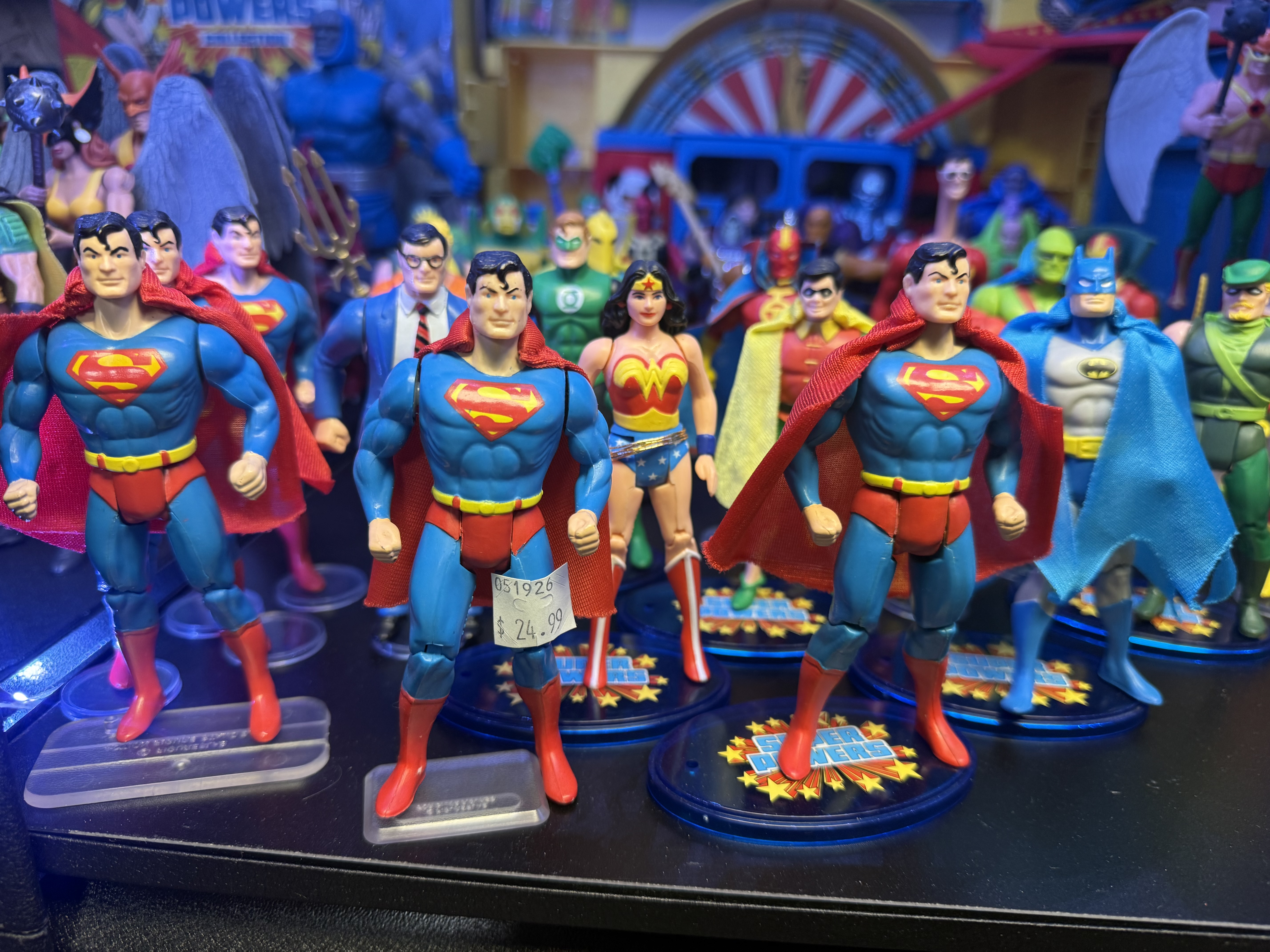
If you have just discovered the Super Powers Collection — in a flea-market bin, in a photo of someone else's shelf, or in a memory of a 1984 toy aisle — this is the page to read first. It covers what the line was, what makes it collectible, and why it stopped so suddenly. Everything else in this guide assumes it.
The line in one paragraph
The Super Powers Collection was Kenner's line of DC Comics action figures, produced across three series from 1984 to 1986 and cancelled abruptly in February 1986. DC had pulled the master toy license from Mego in 1982 — Mego had held the DC and Marvel license through the 1970s — and handed it to Kenner over a competing bid from Mattel. The timing was not an accident: Mattel's Masters of the Universe had just proved that an action feature sells a figure, and Kenner was coming off the Star Wars juggernaut that would wind down the same year Super Powers ended. Kenner leaned on its two strengths, mechanical action features and high-fidelity comic art, and built the line on both.
The finished line comes to 34 figures — arguably 35, if you count the unlicensed Argentine Riddler — plus 8 vehicles, 1 playset, and 1 carrying case. That is the whole universe. It is small enough to be a completable collection and expensive enough at the top end that almost nobody completes it.
Power Action: the gimmick the line is named for
Every figure hides a spring. Squeeze the legs or arms together and the figure performs one signature motion — its "super power." That mechanic is literally where the line got its name, and it is the reason a Super Powers figure feels different in the hand from a Mego or a Secret Wars figure.
- Superman — Power Action Punch
- Aquaman — Power Action Deep Sea Kick
- Hawkman — Power Action Wings, which flap
- Green Lantern — Power Action Ring, with a lantern in the package
Keep one thing in mind as a buyer, because it comes back later in this guide: the action feature is a mechanism, and mechanisms wear. A forty-year-old spring is the single most common thing wrong with a loose Super Powers figure.
The scale everyone gets wrong
Super Powers figures are roughly 4.5 inches tall. They are frequently, confidently, and incorrectly described as 3¾" — the Star Wars scale — including by sellers who ought to know better. The bodies are all plastic, with articulation that was respectable for 1984 and looks sparse now.
The practical consequence is display: at 4.5" these stand noticeably taller than the 3¾" Kenner Star Wars figures they are often shelved beside, and mostly are in scale with the modern McFarlane Super Powers line that revived the brand in 2022.
The art is the other half of the appeal
People collect this line for the packaging as much as the plastic. Most of the figure and packaging art derives from José Luis García-López's DC Style Guides — the drawings that defined how these characters looked on merchandise for a generation — with additional artwork attributed to Dick Giordano and Alex Saviuk
Two comic creators shaped the figures themselves, and both were paid for it, which was rare enough to be worth stating plainly:
- Jack Kirby redesigned his Fourth World characters — Darkseid, Kalibak, Steppenwolf, DeSaad, Mantis, Parademon, Orion and Mister Miracle — for the toys. These were reportedly among the only royalties he ever received for his creations.
- George Pérez designed Cyborg and redesigned Lex Luthor and Brainiac, and received royalties as well.
- Todd Klein - designed new logos for Brainiac and XXXX.
Figures in the first two series also shipped with a mini-comic spotlighting that character. Those pack-ins have become a collecting sub-hobby of their own, with their own checklists and their own gaps.
Why it ended
The cancellation in February 1986 was abrupt, and no single cause explains it. Three pressures stacked up:
- The roster was front-loaded. Series 1 spent the A-list in one go. Later waves leaned on characters a 1985 kid had never heard of, several of them invented for the toyline.
- The aisle got crowded. G.I. Joe, Transformers, M.A.S.K. and Mattel's Secret Wars were all competing for the same shelf and the same allowance.
- Kenner over-packed the cases. Reportedly up to 18 of one character per case of 24 — which produces a glut of the popular figures and a shortage of everything else.
That last point is the one worth carrying into the rest of this guide. The distribution failure of 1984–85 is exactly why some pieces are common enough to buy casually and others are genuinely scarce, and it explains most of what the market looks like today.
Where to go next
Read The Three Waves at a Glance next for the series-by-series breakdown, or jump straight to the records: the Toy Database has every figure, vehicle and playset; the Character Index covers the DC side; and the Timeline lays the whole 1984–86 run against the comics and the cartoons it shipped alongside.
Facts in this article are drawn from the archive's vetted Kenner reference. Where sources disagree — the exact Series 2 figure count, the case-pack ratio — we have said so rather than picking a number.